Physiotherapist Salary in Spain: How Much to Pay in Your Clinic

Deciding how much to pay a physiotherapist is not just a market question, but a strategic decision that directly affects profitability, team stability and the growth of your clinic. A physiotherapist's salary in Spain offers a useful benchmark, but applying an average figure without analysing your own model can lead to mistakes.
Paying below the market rate can lead to constant staff turnover and lost patients. Paying above it without control can squeeze your margins. The key is to understand the external data and combine it with the internal reality of your clinic.
What is a physiotherapist's salary in Spain according to current data
To estimate a physiotherapist's salary in Spain, various industry studies and specialist portals put the average gross annual salary in an approximate range of €21,000 to €30,000 in the private sector, with an average that usually hovers around €24,000 – €27,000 a year.
Platforms such as Talent.comor Jobted show similar figures within that range, while university publications, such as those from the Universidad Francisco de Vitoria, also point to estimates close to €24,000 gross a year, with variations depending on experience, specialisation and geographical location.
As a guide, this translates into the following physiotherapist salaries in Spain:
- Between €1,200 and €1,500 gross a month for junior profiles.
- Between €1,600 and €2,200 gross a month for experienced professionals.
- More than €2,300 gross a month for specialised professionals or those with an established track record.
These figures may vary depending on the autonomous community (Spain's regional governments), clinic size and specialisation. In the public sector, the ranges can be higher, although they depend on competitive public examinations, length of service and regional supplements.
Why the average should not determine your decision
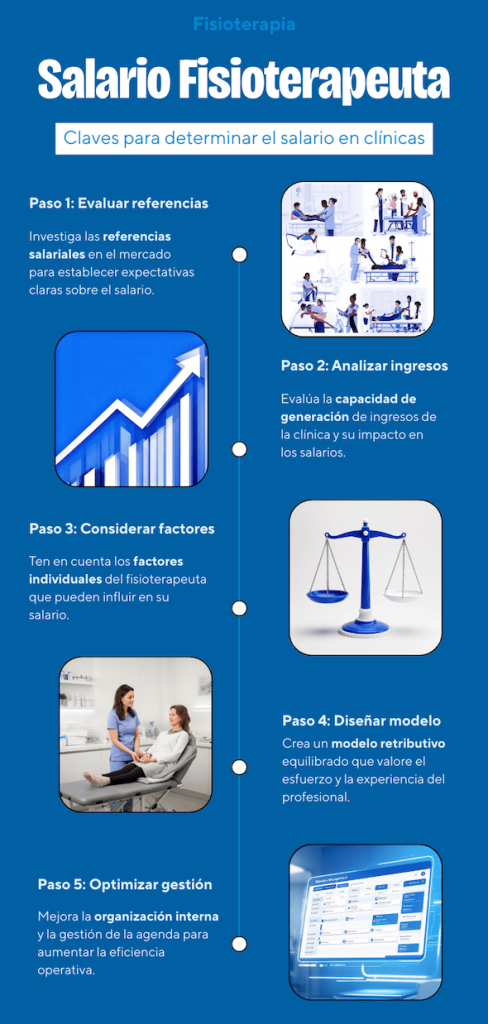
Knowing the average salary is only the starting point. What really matters is how much each physiotherapist can generate within your clinic.
Not all clinics work the same way. There are significant differences in:
- Average price per session.
- Length of treatments.
- Diary occupancy level.
- Brand positioning.
- Type of patient seen.
A clinic with sessions at €40 does not have the same structure as one with sessions at €60. And that difference directly determines the sustainable salary.
That is why, before deciding how much to pay, it is worth analysing each professional's real income-generating capacity.
What factors influence a physiotherapist's salary in Spain
Experience and autonomy
A newly qualified professional needs time to build up a diary and gain clinical confidence. Their initial billing capacity tends to be more limited. By contrast, an experienced physiotherapist brings autonomy, less need for supervision and greater patient loyalty. That difference has a direct impact on income.
Specialisation
Specialisation can make a significant difference. Areas such as sports physiotherapy, pelvic floor, neurology or advanced manual therapy allow you to work with specific niches and, in many cases, justify higher fees. If the professional helps increase the average income per session, their salary can be adjusted accordingly.
Geographical location
A physiotherapist's salary in Spain is not uniform. Large cities tend to require more competitive salaries because of the cost of living and greater competition between clinics. In medium-sized or small cities, the ranges can be somewhat tighter.
How to calculate how much to pay in your clinic
Beyond the national average, the key question is: how much can you pay without compromising profitability.
A practical approach is to calculate:
- The average price per session.
- The number of monthly sessions per physiotherapist.
- The monthly revenue generated.
- The maximum sustainable percentage as a salary cost.
In many private clinics, staff costs represent a significant share of the revenue generated by each professional, which makes it essential to optimise patient acquisition and diary occupancy. In addition, this type of analysis avoids decisions based on intuition and allows you to negotiate using objective criteria.
Fixed salary or variable model
More and more clinics combine a base salary with variable incentives. This model balances stability and motivation.
Some common formulas include:
- Fixed salary plus a percentage of revenue.
- Fixed salary plus a bonus for quarterly targets.
- Incentives linked to diary growth.
The aim is not to reduce the fixed salary, but to align interests. If the physiotherapist increases their revenue and retains patients, both sides win. But for this model to work, you need reliable, transparent data.
The importance of the diary and organisation
This is where many managers make a mistake: they set a physiotherapist's salary without a clear view of real diary occupancy.
If you do not know precisely:
- How many sessions each professional carries out.
- What their cancellation rate is.
- Which time slots are underused.
- Which services generate the highest margin.
Then you are making salary decisions without complete information.
Diary organisation has a direct impact on revenue. A poorly optimised diary reduces income and limits the sustainable salary. A well-managed diary, with automatic reminders and occupancy control, increases financial stability.
How good management helps you pay better
Making decisions about a physiotherapist's salary in Spain based solely on external figures is not enough. What really makes the difference is having precise internal data.
A solution such as ZeeClip for physiotherapy clinics lets you centralise diary, invoicing, clinical records and performance metrics in a single system. This makes it easier to know:
- Real revenue per professional.
- Monthly occupancy rate.
- Income trends.
- The most profitable services.
With this information you can design coherent salary structures, introduce incentives based on real results and plan new hires without putting your cash flow at risk.
When management is clear and the data is reliable, a physiotherapist's salary in Spain stops being an uncertainty and becomes a strategic decision.
Final takeaways on physiotherapist salaries
The salary benchmarks can serve as a guide, but they should not by themselves set a clinic's pay policy. Each centre has a different cost structure and income-generating capacity, and important decisions should be based on that data.
When you know precisely the revenue per professional, the real stability of the diary and the margin per session, the salary stops being a guess and becomes a well-founded decision.
Because paying well is not a matter of external figures, but of internal balance.
If you want to move beyond intuition and rely on real data to set salaries, contact Zeeclip and we will help you turn your clinic's data into a profitable growth strategy.